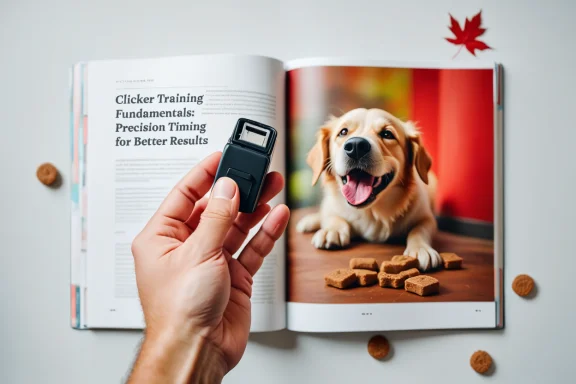
Picture this: you’re at a Calgary dog park watching a owner effortlessly guide their pup through perfect sits, stays, and recalls with nothing but a tiny plastic device. That’s the magic of clicker training, eh? This marker-based method isn’t just another training fad – it’s backed by solid science and used by professional trainers from coast to coast to coast.
Whether you’re dealing with a rambunctious Newfie puppy or teaching an old Golden new tricks, clicker training offers the precision timing your dog needs to understand exactly what behavior earns those coveted rewards.
What Is Clicker Training? The Science Behind the Click
Clicker training operates on the principles of operant conditioning – the same learning theory developed by psychologist B.F. Skinner. The clicker serves as a “bridge” or marker signal that tells your dog the exact moment they’ve performed the correct behavior.
Here’s how it works in your dog’s brain:
The Learning Chain:
- Dog performs desired behavior
- Click sound marks the exact moment
- Reward follows immediately
- Dog connects behavior → click → reward
- Behavior increases in frequency
The beauty of this system lies in its precision. While you might fumble for a treat or struggle to say “good dog” at the perfect moment, that clicker captures the exact second your pup does something right. It’s like having a camera that freezes the perfect training moment.
Why Clicker Training Works Better Than Voice Commands Alone
Consistency is Key Your voice changes with mood, energy levels, and external factors. Tired after a long day at the office? Your “good dog” might sound flat. Excited about your pup’s progress? Your praise might be too enthusiastic and distracting. The clicker sounds identical every single time.
Lightning-Fast Timing Dogs learn through association, and timing is everything. Research shows you have roughly 1.3 seconds to mark a behavior before your dog loses the connection. The clicker bridges that gap with mechanical precision that human reflexes simply can’t match.
Clear Communication Unlike human language, which can be confusing to dogs, the click has only one meaning: “That’s exactly what I wanted!” There’s no ambiguity, no mixed messages – just clear, consistent feedback.
Essential Clicker Training Equipment
The Right Clicker
- Box clickers: Louder click, great for outdoor training
- Button clickers: Quieter option for sensitive dogs or apartment living
- Target sticks with clickers: Perfect for teaching specific positions
Training Treats Choose high-value, small treats that your dog can eat quickly:
- Freeze-dried liver or salmon (great Canadian options from local pet stores)
- Small training treats (pea-sized)
- Soft treats that won’t crumble
Treat Pouch Keep rewards easily accessible. Look for pouches with magnetic closures – they’re quieter and won’t spook noise-sensitive dogs.
Step-by-Step Clicker Training Protocol
Phase 1: Charging the Clicker (Days 1-3)
Before using the clicker for actual training, you need to “charge” it – teaching your dog that click = treat.
The Process:
- Sit quietly with your dog in a distraction-free environment
- Click once and immediately give a treat
- Wait 30 seconds, then repeat
- Continue for 10-15 repetitions per session
- Practice 3-4 short sessions daily
Success Indicator: Your dog immediately looks at you expectantly after hearing the click, even without seeing a treat.
Phase 2: Basic Behavior Capture (Week 1-2)
Start with simple behaviors your dog already offers naturally.
Capturing “Sit”:
- Wait for your dog to sit naturally
- The moment their bottom hits the ground – CLICK!
- Immediately deliver treat
- Repeat until your dog starts offering sits more frequently
- Add the verbal cue “sit” just before they sit
- Practice in different locations around your home
Phase 3: Shaping Complex Behaviors (Ongoing)
Shaping involves breaking complex behaviors into small, achievable steps.
Example – Teaching “Touch” (nose to hand):
- Step 1: Click for looking at your hand
- Step 2: Click for moving toward your hand
- Step 3: Click for getting closer to your hand
- Step 4: Click only for actual nose contact
- Step 5: Add verbal cue “touch”
Common Canadian Training Challenges and Solutions
Winter Weather Training Those long Canadian winters can interrupt outdoor training routines. Use hallways, basements, or garages for continued practice. Focus on precision behaviors that don’t require lots of space.
Multi-Dog Households Popular across Canadian families! Train dogs separately initially. The clicking sound might excite other dogs, leading to chaos. Once each dog understands the system, you can work with them together.
Apartment Living Urban Canadians in Toronto, Vancouver, or Montreal condos can successfully clicker train. Use quieter button clickers and focus on calm behaviors like “settle” and “place.”
Troubleshooting Your Clicker Training
Problem: Dog Doesn’t Respond to Click
- Solution: Return to charging phase. Some dogs need 50+ repetitions to make the connection.
Problem: Dog Becomes Obsessed with Clicker
- Solution: Keep clicker hidden until needed. Only bring it out for training sessions.
Problem: Timing Feels Off
- Solution: Practice clicking while watching TV. Click every time a character says a specific word to improve your reflexes.
Problem: Dog Gets Too Excited
- Solution: Lower your treat value or take training breaks. Some dogs need to learn impulse control first.
Advanced Clicker Applications
Once you’ve mastered the basics, clicker training opens doors to incredible possibilities:
- Complex trick sequences
- Service dog tasks
- Agility training
- Behavioral modification for anxiety or reactivity
- Cooperative care (nail trims, vet visits)
The Bottom Line: Why Canadian Dog Owners Choose Clicker Training
Clicker training isn’t just effective – it’s humane, science-based, and builds genuine partnership between you and your dog. Unlike punishment-based methods, it creates eager, confident learners who actively participate in their own training.
From the busy streets of downtown Toronto to the hiking trails of British Columbia, Canadian dog owners are discovering that this simple tool creates remarkable results. The precision timing eliminates confusion, builds trust, and makes training sessions something both you and your dog look forward to.
Ready to start your clicker journey? Remember – consistency beats perfection every time. Even if your timing isn’t perfect initially, you’re still building a communication system that will serve you and your four-legged family member for years to come.
Take the next step: Grab a clicker from your local Canadian pet store, stock up on high-value treats, and commit to just five minutes of daily practice. Your dog’s transformation will surprise you – guaranteed!